French Roulette: Odds, Special Rules & Player Advantages
French Roulette is the cheapest form of the game that exists. The wheel is the same 37-pocket single-zero wheel as European Roulette; what changes is the rule on zero. Under La Partage or En Prison, an even-money bet loses only half its stake when the ball lands in the green pocket, and that single concession cuts the house edge on those bets from 2.70% to 1.35%. No other mainstream casino table offers a lower price on a bet.
This page covers what makes the French table different: the zero rules and their exact arithmetic, the French layout and vocabulary, and the announced bets, Voisins du Zéro, Tiers du Cylindre and Orphelins, which are the one part of roulette that most players never properly learn. It also publishes a 10,000-spin simulation run on the same spins as the European page, so you can see in money what La Partage is worth. Spoiler: on that run, €1,395.
- Half a Zero, in Numbers
- La Partage and En Prison, Exactly
- The French Layout and Its Vocabulary
- Payout Structure
- The French Bets: Voisins, Tiers, Orphelins
- Variance Test: What La Partage Is Worth
- French vs European vs American
- How the French Table Came About
- Playing It Well
- Frequently Asked Questions
Half a Zero, in Numbers
On a 37-pocket wheel, a bet on red wins 18 times out of 37 and loses 19 times. The casino’s edge comes from the one losing outcome that is neither red nor black: the zero. On a European table, zero takes your whole stake, and the edge is 1 in 37, or 2.70%. On a French table, zero takes half, and the edge is half of 1 in 37, or 1.35%. That is the entire difference between the two games, and it applies only to the six even-money bets: red, black, odd, even, low and high.
Everything else on the French table, every straight-up number, split, street, corner, six line, dozen and column, is priced at the normal 2.70%. So French Roulette is not a cheaper wheel. It is a cheaper wheel for one family of bets, and the player who benefits is the one who keeps their money on that family.
Key Facts at a Glance
| Fact | French Roulette | Why it matters |
|---|---|---|
| Pockets | 37 (0, 1 to 36) | Same wheel and sequence as European |
| Edge on even-money bets | 1.35% | With La Partage or En Prison |
| Edge on all other bets | 2.70% | The zero rules do not cover them |
| Return on even-money bets | 98.65% | The best price in mainstream casino roulette |
| Straight-up payout | 35:1 | Fair would be 36:1 |
| Expected cost, 100 even-money spins at €10 | €13.51 | Against €27.03 European and €52.63 American |
| Racetrack (announced bets) | Standard | The French bets are native to this table |
| Layout | Outside bets on both sides of the grid, French labels | Looks different, plays the same |
La Partage and En Prison, Exactly
A French table offers one of two rules on zero. They produce the same long-run cost but feel very different at the table, and some online versions offer only one of them, so it pays to know both.
La Partage (“the sharing”)
Zero lands. The croupier takes half of every even-money stake and returns the other half. The hand is over. A €10 bet on red loses €5 instead of €10. Over 37 spins with one zero among them, the expected loss on red is 18 wins of €10, 18 losses of €10, and one loss of €5: net minus €5 across €370 staked, which is 1.35%.
En Prison (“in prison”)
Zero lands. Your even-money stake is not taken but is marked and left in place for the next spin. If that next spin wins for your bet, the stake is released back to you in full, with no winnings. If it loses, the stake is gone. Half the time you get €10 back, half the time you lose €10, so the expected loss on a zero is €5, exactly as under La Partage. Tables vary on what happens if zero lands again while a bet is in prison: some take it, some keep it imprisoned, and a few online versions apply La Partage at that point. The rule card at the table, or the info panel online, will say which.
The full comparison of the two rules, including the double-zero edge case, is on the La Partage and En Prison rules page. For most players the practical difference is temperament: La Partage settles the matter at once, En Prison gives you a spin of hope. The price is identical.
The French Layout and Its Vocabulary
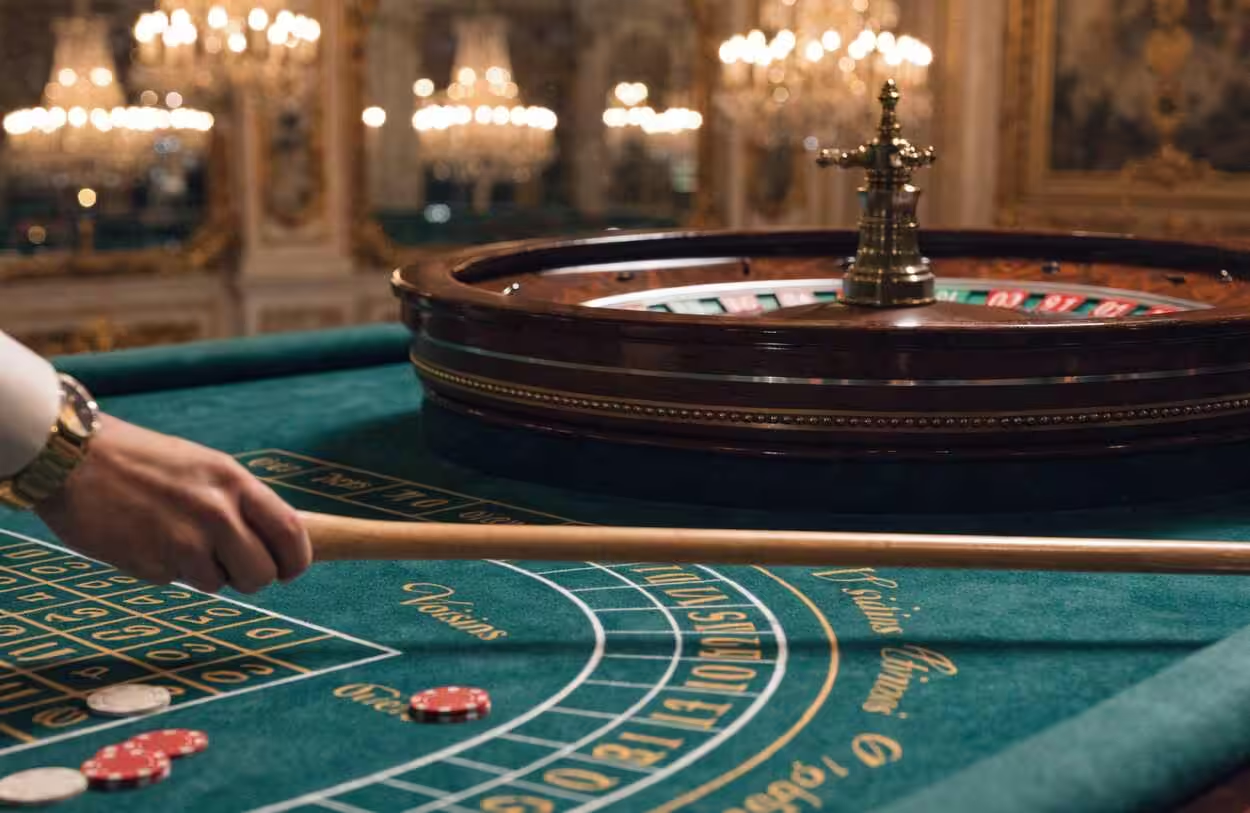
A French table is laid out differently from the American-style table used for most European Roulette. The wheel sits at one end of a long table, the number grid runs away from it, and the outside bets are split along both long sides so that players can sit on either side and reach them. Croupiers use a long rake, the râteau, to move chips, and the table runs with a team rather than a single dealer. Every bet has a French name, and even where the game is dealt in English, the names stay on the cloth.
| On the cloth | Meaning | Pays |
|---|---|---|
| Rouge / Noir | Red / Black | 1:1 |
| Pair / Impair | Even / Odd | 1:1 |
| Manque / Passe | Low (1 to 18) / High (19 to 36) | 1:1 |
| Première, Moyenne, Dernière douzaine | First, second, third dozen (P12, M12, D12) | 2:1 |
| Colonne | Column | 2:1 |
| Plein | Straight up, one number | 35:1 |
| Cheval | Split, two numbers | 17:1 |
| Transversale pleine | Street, three numbers | 11:1 |
| Carré | Corner, four numbers | 8:1 |
| Sixain | Six line, six numbers | 5:1 |
The call that closes betting is “rien ne va plus”, nothing more goes, and on a French table it is enforced strictly: a chip placed after the call is returned, not played. The wider vocabulary of the game, French and English, is collected in the roulette terms and glossary.
Payout Structure
The table below shows each bet against its fair payout, what it would pay if the house kept nothing. The even-money rows carry two edges: what you pay under La Partage, and what the same bet costs on a European table without it.
| Bet | Numbers | Win chance | Pays | Fair payout | Edge, French |
|---|---|---|---|---|---|
| Rouge / Noir, Pair / Impair, Manque / Passe | 18 | 48.65% | 1:1 | 1.056:1 | 1.35% (2.70% without La Partage) |
| Douzaine / Colonne | 12 | 32.43% | 2:1 | 2.083:1 | 2.70% |
| Sixain | 6 | 16.22% | 5:1 | 5.17:1 | 2.70% |
| Carré | 4 | 10.81% | 8:1 | 8.25:1 | 2.70% |
| Transversale | 3 | 8.11% | 11:1 | 11.33:1 | 2.70% |
| Cheval | 2 | 5.41% | 17:1 | 17.5:1 | 2.70% |
| Plein | 1 | 2.70% | 35:1 | 36:1 | 2.70% |
Where each chip goes on the grid is mapped, bet by bet, on the roulette bet options page.
The French Bets: Voisins, Tiers, Orphelins
Bets on the Wheel, Not the Grid
The announced bets, also called call bets or sector bets, are the part of roulette that is native to the French table. Instead of covering numbers that sit together on the grid, they cover numbers that sit together on the wheel, and they are placed in one go by name or on the racetrack, the oval printed with the wheel sequence.
They do not lower the edge: each is a bundle of ordinary splits, corners and straight-ups, and each component is priced at 2.70%. What they offer is a way to bet on a physical arc of the wheel with a single call.
They are defined by the single-zero sequence, clockwise from zero: 0, 32, 15, 19, 4, 21, 2, 25, 17, 34, 6, 27, 13, 36, 11, 30, 8, 23, 10, 5, 24, 16, 33, 1, 20, 14, 31, 9, 22, 18, 29, 7, 28, 12, 35, 3, 26. The three main bets divide that circle into three arcs with nothing left over.
| Bet | Numbers covered | Chips | How the chips are placed | Win chance |
|---|---|---|---|---|
| Voisins du Zéro (neighbours of zero) | 17: the arc from 22 to 25 through zero | 9 | 2 on the 0-2-3 street, 2 on the 25-26-28-29 corner, 1 each on the splits 4/7, 12/15, 18/21, 19/22, 32/35 | 45.9% |
| Tiers du Cylindre (third of the wheel) | 12: the arc from 27 to 33, opposite zero | 6 | 1 each on the splits 5/8, 10/11, 13/16, 23/24, 27/30, 33/36 | 32.4% |
| Orphelins (orphans) | 8: the two short arcs left over, 17-34-6 and 1-20-14-31-9 | 5 | 1 straight up on 1, 1 each on the splits 6/9, 14/17, 17/20, 31/34 | 21.6% |
| Jeu Zéro (zero game) | 7: the tight arc 12 to 15 around zero | 4 | 1 each on the splits 0/3, 12/15, 32/35, 1 straight up on 26 | 18.9% |
Two things follow from the chip counts. First, these bets are not even-money bets, so La Partage does not apply to them; a Voisins bet that loses, loses all nine chips. Second, the payout depends on which number hits. A Voisins bet that lands on 26 pays the corner, 8:1 on two chips, while the other seven chips lose, for a net profit of 9 chips. Land on 4 and the split pays 17:1 on one chip, eight chips lose, net profit 9 chips. Land on 0 and the street pays 11:1 on two chips, net profit 15. The win rate is high, the typical profit is modest, and the long-run cost is 2.70% of everything staked, like every other inside bet.
Neighbour bets, “17 and the neighbours”, cover a number and the two pockets on either side of it on the wheel, five straight-up chips in total. Finals, “finale 5”, cover every number ending in that digit. Both are placed on the same racetrack and follow the same logic: wheel geometry, standard pricing. The physical layout of the wheel itself, and why the sequence is arranged as it is, is on the roulette wheel page.
Variance Test: What La Partage Is Worth
To put a figure on the rule, I took the exact 10,000-spin sequence used on the European page, same seed, same 37-pocket wheel, same €10 on red every spin, and replayed it under La Partage. The only thing that changes is that each of the 279 zeros in that sequence takes €5 instead of €10. That makes this the cleanest comparison it is possible to run: identical luck, different rule.
| After spin | European (zero takes all) | French (La Partage) | Saved |
|---|---|---|---|
| 100 | -€180 | -€160 | €20 |
| 500 | -€560 | -€500 | €60 |
| 1,000 | -€380 | -€285 | €95 |
| 2,500 | -€580 | -€240 | €340 |
| 5,000 | -€2,260 | -€1,580 | €680 |
| 7,500 | -€2,880 | -€1,850 | €1,030 |
| 10,000 | -€4,480 | -€3,085 | €1,395 |
€1,395 saved on €100,000 staked, which is 1.40% of turnover against the theoretical 1.35%. The run itself was an unlucky one, red came up 4,776 times instead of the expected 4,865, and the French player still finished well below the theoretical -€1,351. The rule did not rescue a bad run. It made the bad run cheaper by exactly the amount the maths said it would, which is what a rule can do and what a system cannot.
1,000 Short Sessions: How Often Do You Walk Away Ahead?
I also replayed the 1,000 sessions of 100 spins from the European test under La Partage. 469 sessions out of 1,000 ended in profit, 46.9%, against a theoretical 43.7%; the same spins without La Partage produced 378 winning sessions. The median session lost €10. One in ten sessions lost €130 or more; one in ten won €115 or more. Best session +€235, worst -€285. On a French table an evening on red is close to a coin flip. On an American table the same evening wins one time in four.
French vs European vs American
| Variant | Pockets | Edge (even money) | Edge (all other bets) | Expected cost, 100 spins at €10 | Sessions ending in profit |
|---|---|---|---|---|---|
| French (La Partage) | 37 | 1.35% | 2.70% | €13.51 | 43.7% |
| European | 37 | 2.70% | 2.70% | €27.03 | 35.5% |
| American | 38 | 5.26% | 5.26% (7.89% five-number) | €52.63 | 26.5% |
The French and European roulette tables are the same wheel; the difference is a rule you can check in thirty seconds. The American roulette wheel is a different object with an extra pocket, and it costs four times as much per evening as a French table on the same bet. If you remember one number from this page, make it the last column.
How the French Table Came About
| Year | What happened | Why it matters |
|---|---|---|
| 1655 | Blaise Pascal, working on perpetual motion, builds a spinning wheel that is often cited as the ancestor of the roulette wheel. | The French claim on the game starts here, whatever the mechanism actually was. |
| 1796 | Roulette is described in its modern form in Paris, with a zero and a double zero. | The game is French from the start; the single zero is not. |
| 1843 | François and Louis Blanc introduce the single-zero wheel at Bad Homburg. | The wheel the French table still uses today. |
| 1863 | François Blanc takes over the Monte Carlo casino. The single-zero wheel, the French layout, the rake and the French vocabulary become the house style. | Monte Carlo fixes the image of “French Roulette” that casinos still copy. |
| 20th century | La Partage and En Prison spread through French and Monégasque casinos as a courtesy on even-money bets. | The 1.35% edge becomes the defining feature of the French game. |
| Online era | Software and live studios offer “French Roulette” as a separate title, usually with La Partage built in. | The cheapest version of the game becomes available to anyone with a browser. |
The longer version of this story, including the New Orleans crossing and why America kept the double zero, is on the history of roulette page.
Playing It Well
French Roulette rewards one specific discipline: keeping your money on the bets the rule covers. Everything below follows from that.
- Confirm the rule before the first spin. A game titled French Roulette almost always has La Partage or En Prison, but the info panel is the only proof. Search it for “partage” or “prison”.
- Stay on even money. Rouge, noir, pair, impair, manque, passe. The moment you move to dozens, columns or the racetrack, you are paying double.
- Treat the French bets as entertainment, not edge. Voisins and Tiers are an elegant way to play the wheel, and they cost the standard 2.70%. Know that going in.
- Count in spins. At €10 a spin on even money, a hundred spins costs about €13.50 in expectation. That is the price of the evening; the swing around it is luck.
- Expect to win a little under half your evenings. 43.7% is the best figure in mainstream roulette and it is still below 50%. Enjoy the winning ones; do not chase the others.
Frequently Asked Questions
What is the house edge on French Roulette?
1.35% on even-money bets (red/black, odd/even, low/high) under La Partage or En Prison, and 2.70% on all other bets. The wheel is the same 37-pocket single-zero wheel as European Roulette; only the rule on zero differs.
What is the difference between French and European Roulette?
Same wheel, same sequence, same payouts. French Roulette adds La Partage or En Prison, which return half of an even-money stake when zero lands, cutting the edge on those bets from 2.70% to 1.35%. The French table also uses a different layout with outside bets on both sides and French labels such as Rouge, Noir, Pair, Impair, Manque and Passe.
What is La Partage?
French for “the sharing”. When zero lands, every even-money bet loses half its stake and the other half is returned. A €10 bet on red loses €5 instead of €10, which halves the house edge on that bet to 1.35%.
What is En Prison?
French for “in prison”. When zero lands, an even-money stake stays on the table for the next spin. If that spin wins, the stake is returned in full with no winnings; if it loses, the stake is taken. The expected cost is the same 1.35% as La Partage.
What are the French bets in roulette?
Announced bets that cover arcs of the wheel rather than areas of the grid. Voisins du Zéro covers 17 numbers around zero with 9 chips, Tiers du Cylindre covers 12 numbers opposite zero with 6 chips, Orphelins covers the remaining 8 numbers with 5 chips, and Jeu Zéro covers 7 numbers around zero with 4 chips. They are placed on the racetrack and priced at the standard 2.70%.
Does La Partage apply to the French bets?
No. La Partage and En Prison apply only to even-money bets. Voisins, Tiers, Orphelins, dozens, columns and all inside bets pay the normal 2.70% house edge on a French table.
How much does La Partage save over 10,000 spins?
In a seeded simulation of 10,000 spins at €10 on red, the same spin sequence lost €4,480 without La Partage and €3,085 with it, a saving of €1,395 on €100,000 staked, or 1.40% of turnover against the theoretical 1.35%.