
European Roulette is the international standard, the version played from Monte Carlo to Macau. A single green zero, 37 numbered pockets, and a house edge of 2.70%. This is the variant most players should choose when given the option, and the one the entire strategy hub here is calibrated to. Below: the rules, the math, the bets worth placing, how it differs from the American and French wheels, and how to play it for real money without losing more than you should.
What Is European Roulette?
European Roulette is played on a wheel with 37 numbered pockets: 0 and 1 through 36. The single green zero is the defining feature. It cuts the house edge in half compared to the American version, which carries a second green pocket. The game was invented in 18th-century France and refined in the casinos of Bad Homburg and Monte Carlo, where the single-zero wheel became the standard for European gaming.
Where the Single Zero Came From
The wheel you play today was a competitive move. Until the 1840s European wheels carried both a zero and a double zero, exactly like the American version still does. In 1843 François and Louis Blanc opened a casino in Bad Homburg with a wheel that had only one green pocket, halving the house edge to undercut every rival in the region.
It worked. When the brothers moved the operation to Monte Carlo two decades later, the single-zero wheel came with them and became the standard for the whole continent. That one design decision is still the difference between paying 2.70% and paying 5.26%.

Today the single-zero wheel dominates online platforms worldwide and is the default in most non-American physical casinos. If a table offers both versions and the minimum bets are similar, the European wheel is always the mathematically smarter choice. The full pocket-by-pocket comparison sits in the house edge by variant breakdown.
What is the best software for this table game? We prefer the games from Evoplay because this version is very good and fast on mobile and has no advertising or other widgets. Evoplay is to play at Stake or anonymous casino.
European Roulette on Mobile
Most European tables now get played on a phone, and the software matters more there than on desktop. A good mobile build keeps the full betting grid reachable with one thumb, shows the announced-bet racetrack without a separate menu, and does not repaint the layout between spins.
Stakes tend to start lower on mobile, often from €0.10, which makes it the cheapest place to test a progression before committing real money at a live table. The maths is identical: 37 pockets, 2.70%, 35:1 on a straight-up number, whatever screen you are on.
Practise the exact same wheel with no signup in the free roulette simulator.

Key Facts at a Glance
| Feature | European Roulette |
|---|---|
| Wheel pockets | 37 (0, 1 to 36) |
| Green zeros | 1 (single zero) |
| House edge | 2.70% |
| RTP (Return to Player) | 97.30% |
| Straight-up payout | 35:1 |
| Five-number bet | Not available |
| La Partage / En Prison | Sometimes (variant-dependent) |
| Announced bets | Yes (Voisins, Tiers, Orphelins) |
European Roulette Rules & Table Layout
The mechanics are universal across roulette variants. The dealer spins the wheel one way and releases the ball the other way. Players place chips on the betting layout until the dealer calls “Rien ne va plus”, no more bets. The ball settles in a pocket, winning bets are paid, losing chips are swept. A full walkthrough sits in the roulette rules section.
The European layout is single-zero only, with the zero positioned at the top of the betting grid. Inside bets sit on the numbered grid; outside bets line the edges. Each bet type, where the chips go and what it pays, is mapped in the bet options reference.
Inside Bets
| Bet Type | Coverage | Payout | Win Probability |
|---|---|---|---|
| Straight Up | 1 number | 35:1 | 2.70% |
| Split | 2 numbers | 17:1 | 5.41% |
| Street | 3 numbers | 11:1 | 8.11% |
| Corner (Square) | 4 numbers | 8:1 | 10.81% |
| Six Line | 6 numbers | 5:1 | 16.22% |
Outside Bets
| Bet Type | Coverage | Payout | Win Probability |
|---|---|---|---|
| Red / Black | 18 numbers | 1:1 | 48.65% |
| Odd / Even | 18 numbers | 1:1 | 48.65% |
| Low (1 to 18) | 18 numbers | 1:1 | 48.65% |
| High (19 to 36) | 18 numbers | 1:1 | 48.65% |
| Dozen | 12 numbers | 2:1 | 32.43% |
| Column | 12 numbers | 2:1 | 32.43% |
European vs American vs French
Three wheels, three house edges. The number of green pockets and the rule applied when zero lands are what separate them. Everything else, the payouts, the bet types, the table layout, is effectively identical.
| Variant | Pockets | Green zeros | House edge | Loss per €1,000 wagered |
|---|---|---|---|---|
| European | 37 | 1 (single 0) | 2.70% | €27 |
| American | 38 | 2 (0 and 00) | 5.26% | €52.60 |
| French (La Partage) | 37 | 1 (single 0) | 1.35% on even-money | €13.50 even-money |
The European wheel beats the American wheel for one reason: the double-zero wheel adds a 38th pocket, which doubles the edge to 5.26% without changing a single payout. Same 35:1 on a straight-up number, worse odds of hitting it. There is never a mathematical case for choosing the double-zero wheel when a single-zero table is open.
French Roulette runs on the same 37-pocket wheel as the European game, so on inside bets the edge is identical at 2.70%. The difference is La Partage: when zero lands, you lose only half your even-money stake instead of all of it, which drops the edge on Red/Black, Odd/Even and Low/High to 1.35%. If you bet even-money and a French table is available, it is the strongest version of roulette you can play.
The Wheel Sequence
Reading the Sequence
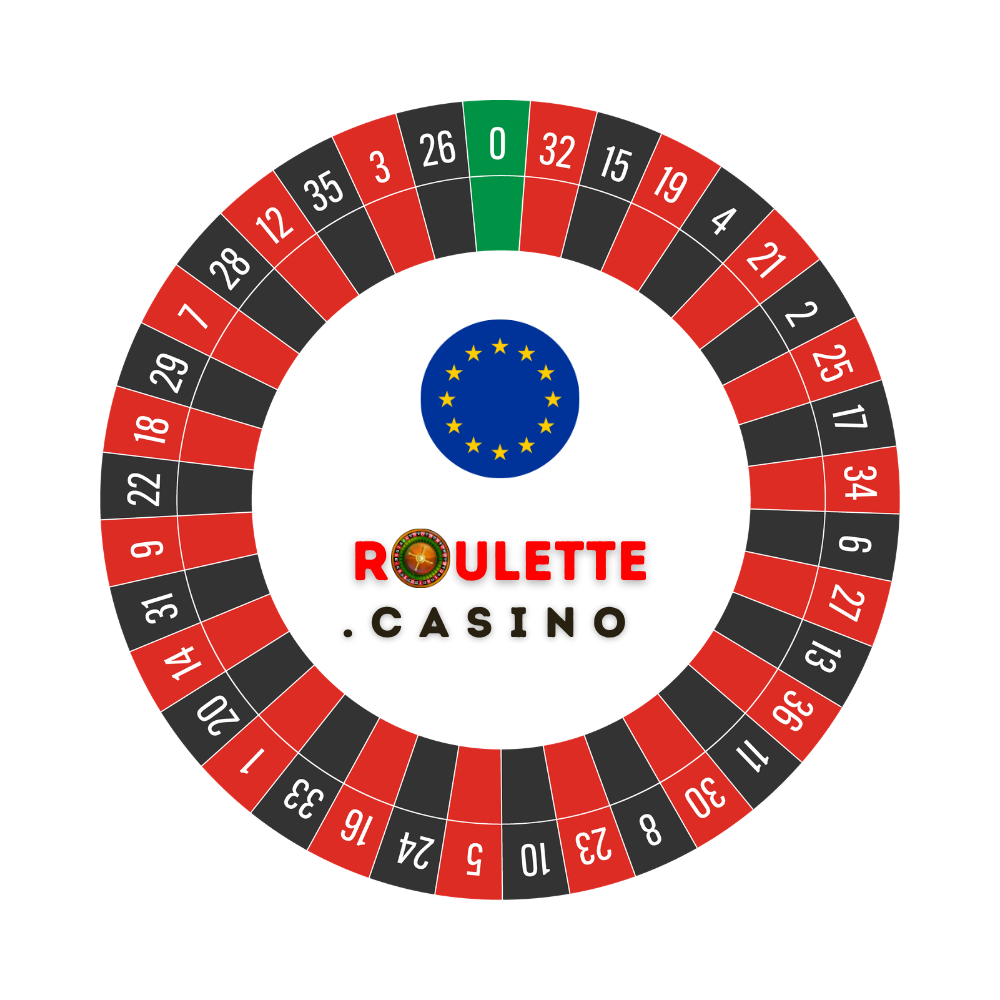
The order around the rim is not sequential. It runs 0, 32, 15, 19, 4, 21, 2, 25, 17, 34, 6, 27, 13, 36, 11, 30, 8, 23, 10, 5, 24, 16, 33, 1, 20, 14, 31, 9, 22, 18, 29, 7, 28, 12, 35, 3, 26 — and then back to zero.
It looks arbitrary. It is engineered. Red and black alternate at every single pocket, without one exception on the whole wheel. Odd and even split nine to nine in each half, so neither side of the cylinder leans one way. High and low alternate almost perfectly too: across all 37 pockets there is exactly one place where two numbers from the same half sit side by side, at 10 and 5.
That balance is what makes the announced bets honest. Voisins du Zéro, Tiers du Cylindre and Orphelins cover physical arcs of the rim rather than boxes on the grid, and an unbalanced sequence would hand one of those arcs a hidden bias.
Why the Math Works
On a straight-up bet your win probability is 1 in 37. The casino pays 35:1. A fair payout would be 36:1. That one missing unit, spread across 37 outcomes, produces the 2.70% edge, exactly half the American figure because there is one fewer green pocket.
European Roulette Odds & Payouts
Every bet on the European wheel carries the same 2.70% house edge. There is no equivalent of the American Five Number Bet to avoid. That uniformity makes the game easy to play strategically: every bet has equal long-term expected value, so you choose bets on variance preference rather than edge.
Variance: Pick Your Risk Level
- Lowest variance: Red/Black, Odd/Even, High/Low, near 48.65% win rate at 1:1. Long sessions, slow grind.
- Medium variance: Dozens and Columns, 32.43% win rate at 2:1. Balanced sessions.
- Highest variance: Straight-up numbers, 2.70% win rate at 35:1. Short bursts, big swings.
The full odds and payouts chart covers every bet combination, and the payout calculator works out returns for any stake.
Announced & Call Bets
European tables, particularly French-style and live dealer versions, offer a set of pre-defined multi-number bets called announced bets or call bets. These cover physical sections of the wheel rather than the betting grid, and they are unavailable on American tables.
| Bet Name | Coverage | Chips Required |
|---|---|---|
| Voisins du Zéro | 17 numbers around 0 | 9 chips |
| Tiers du Cylindre | 12 numbers opposite 0 | 6 chips |
| Orphelins | 8 numbers in two gaps | 8 chips (en plein) or 5 (à cheval) |
| Jeu Zéro | 7 numbers nearest 0 | 4 chips |
| Finales | Numbers ending in the same digit | 3 to 4 chips |
Chip placement for each of these is mapped in the bet options reference, and the La Partage and En Prison rules that pair with them are covered under La Partage and En Prison.
Strategies for the European Wheel
European Roulette is the variant most systems are designed for. The 2.70% edge gives progressions more room to work, the announced bets allow wheel-section coverage, and the absence of a Five Number Bet means there is no trap to avoid. Every bet on the table shares the same edge, so the job is managing variance, not hunting for a better number.
Martingale System
Double your even-money bet after every loss. One win recovers everything lost plus a single unit of profit. It runs marginally better on the European wheel because even-money bets win 48.65% of the time versus 47.37% on the American wheel, though the core risk of a long losing streak is unchanged.
Fibonacci System
Bet sizes follow the Fibonacci sequence: 1, 1, 2, 3, 5, 8, 13 and so on. Gentler than Martingale but slower to recover, which suits longer European sessions.
D’Alembert System
Add one unit after a loss, subtract one after a win. The most conservative progression, suited to European sessions where you want minimal variance and steady play.
James Bond Strategy
A flat-bet system covering 25 of 37 numbers in one round: €140 on 19 to 36, €50 on the six-line 13 to 18, €10 on zero. Built specifically for the single-zero wheel.
Every system across every variant sits in the strategy index.
Playing European Roulette for Real Money
Online European Roulette is the most widely available variant on licensed platforms: lower minimums, often €0.10 stakes, faster play, and demo modes for testing strategy. Most casinos run several skinned versions, premium, gold, immersive, but the underlying math holds at 2.70% across all of them.
Live dealer tables stream a real croupier and a physical European wheel in HD, with Evolution and Pragmatic Play dominating the segment.
What to Look for in a Casino
- Licensing. MGA, UKGC or an equivalent authority, nothing less.
- Certified RTP. An eCOGRA or iTech Labs audit confirming 97.30%.
- Bet range. Minimums under €1 and maximums high enough to run a progression without hitting the ceiling.
- Announced bets supported. Confirm Voisins, Tiers and Orphelins are available if you plan to use them.
- Live dealer option. For the closest experience to a physical European table.
Frequently Asked Questions
What is the house edge on European Roulette?
2.70% on every bet. The single green zero produces this edge uniformly across all inside and outside bets, with no equivalent of the American Five Number Bet trap. Compare to 5.26% on the American wheel and 1.35% on French Roulette with La Partage.
Is European Roulette better than American Roulette?
Statistically yes, by a large margin. The European 2.70% house edge is exactly half of the American 5.26%. Over the same number of spins at the same stake, you lose roughly half as much on the European wheel. If both are available, choose European.
How many numbers are on a European Roulette wheel?
37 numbers: 0 and 1 through 36. Numbers 1 to 36 alternate between red and black. The 0 pocket is green.
What is the payout for a straight-up number bet?
35:1. A €10 straight-up bet returns €350 in winnings plus your €10 stake on a win. Your probability of winning is 1 in 37, or 2.70%.
What happens when zero lands?
On standard European Roulette, all outside bets lose when zero hits. Some variants apply La Partage (half your even-money bet is returned) or En Prison (the bet is held for the next spin), which cut the edge to 1.35%. Check the table rules before playing, and see the French Roulette page for the full La Partage breakdown.
What are announced bets?
Pre-defined multi-number bets that cover physical sections of the wheel rather than the betting grid. Voisins du Zéro covers 17 numbers around zero, Tiers du Cylindre covers 12 opposite, Orphelins covers the 8 numbers in the remaining gaps. Available on most European and all French tables.
Can I use the Martingale system on European Roulette?
Yes, and it runs marginally better than on the American wheel because even-money bets win 48.65% of the time instead of 47.37%. The core risk is unchanged: a long losing streak can exhaust your bankroll or hit the table maximum before recovery. Read the full Martingale breakdown first.
What is the RTP of European Roulette?
97.30%. For every €100 wagered over millions of spins, the game returns €97.30 on average, leaving €2.70 as the house edge. That is well above typical slot RTPs of 92 to 96%, and a key reason roulette is one of the better-value casino games.