
Hot and cold numbers
Inside This Guide

Before going further: on a fair wheel, every spin is independent. Past results have zero influence on future outcomes. Every number has an equal probability of appearing on every spin. The rest of this guide assumes you accept that — and explains what tracking is actually good for.
What Hot & Cold Numbers Actually Are
The terminology is straightforward. A hot number is one that has appeared more often than expected in a recent sample of spins. A cold number is one that has appeared less often than expected, or not at all. Most live and online roulette interfaces display a “history” panel showing the last 10, 50, or 500 results, often with the hottest and coldest numbers highlighted.The conceptual mistake is treating that history as predictive. It isn’t. On a properly functioning European wheel, each of the 37 pockets has a probability of 1/37 (2.70%) on every spin, regardless of what happened on the previous spin, the previous hundred spins, or the previous thousand. The wheel is not “catching up.” It is not “due.” It is doing exactly what random looks like, which includes long streaks and absences that feel like patterns.2.70%
Probability per number, every spin
1 in 37
Odds on a single number (European)
0%
Influence of past spins on next spin
Hot Numbers Explained
A hot number is a record of what already happened, dressed up as a prediction. Some players bet on hot numbers because they assume the run will continue. Others read the same data as a warning that the streak has gone on too long and switch to cold numbers instead. Both groups are reading the same noise — they just disagree about which direction the noise points.In a sample of, say, 100 spins on a European wheel, the expected number of hits for any single number is roughly 2.7. Numbers landing five or six times in that sample look strikingly “hot” but are entirely consistent with random variance. Numbers missing the sample entirely are equally consistent. Run another 100 spins and the hot list will look almost completely different — which is what randomness produces and what predictive patterns wouldn’t.What tracking is actually good for: entertainment, session pacing, and (in extreme cases) detecting genuine wheel bias on a physical table over thousands of spins. Three good reasons. Predicting the next spin is not on the list.
Cold Numbers Explained
Cold numbers are the inverse — numbers that have stayed quiet across a recent sample. The misconception that surrounds them is the same as the hot-number one, just flipped: the idea that a number “should have hit by now” and is therefore overdue.This is the gambler’s fallacy in its purest form. The wheel does not balance itself. A number missing for 200 spins on a fair wheel has exactly the same probability on spin 201 as it did on spin 1. Two hundred is a smaller sample than it sounds — the probability of any specific number missing 200 consecutive spins on European roulette is about 0.4%, which sounds rare but means it happens to a different number every few hundred spins somewhere on the table.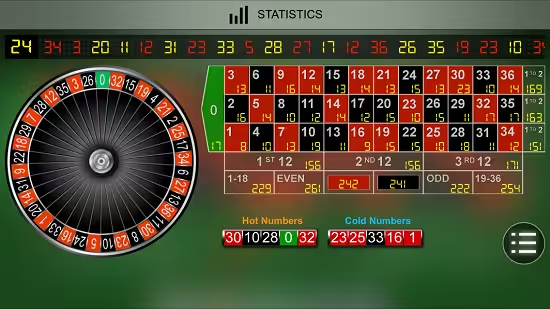
The Math Behind Random Spins
The underlying principle is independence. The probability of an event does not change based on previous events of the same type when those events are independent — and a fair roulette spin is independent by design.The classic example: ten black results in a row. Surely the next spin must be red? On a European wheel, the probability of red on spin 11 is still 18/37, or 48.65%. Identical to what it was on spin 1, identical to what it will be on spin 12, identical to what it is forever on a fair wheel. The streak of ten blacks is real. The implication that red is now “due” is not.The same logic applies in the other direction. A number that has appeared three times in the last twenty spins is not “hot” in any predictive sense. It is a number that happened to land three times in a 20-spin sample where the expected count was 0.54. That’s variance, not momentum.The size of the sample matters: over 37 spins, anywhere from 0 to 8 hits on a single number falls within normal variance. Over 370 spins, the range tightens but the expected count is still only 10 hits — three or four either way is still ordinary. Patterns that feel obvious in a 100-spin window almost always disappear in a 1,000-spin window.
The Cold-Number Method, Honestly Assessed
The most common betting approach built around this concept works as follows:| Step | Action | What it does — and doesn’t — do |
|---|---|---|
| 1 | Observe the first 30–50 spins of a session | Builds a list of which numbers haven’t appeared yet. Useful for structure, not prediction. |
| 2 | Identify six or fewer numbers that haven’t hit | Defines your bet selection. The selection is arbitrary — any six numbers have the same expected return. |
| 3 | Place one chip on each cold number | Total stake of six units, coverage of 16.22%. Expected loss per spin: stake × 2.70%. |
| 4 | Continue until one hits, then reset | If one hits you receive 35:1 on that chip (net +30 units). If none hit you lose 6 units. |
What this means in practice: the cold-number method is a structured way of choosing bets. It is not a system that beats the house. Anyone presenting it as a way to gain a mathematical advantage is selling story, not math. See the full strategies hub for systems that at least restructure variance honestly, even though none of them beat the edge either.
Use our free roulette simulator to test any approach over thousands of spins before risking real money. The simulator is the most efficient way to see firsthand why pattern-based selection produces the same long-run result as any other selection.
When Tracking Does Matter
There is one narrow scenario where number tracking is genuinely useful, and it has nothing to do with online RNG roulette. On a physical wheel, mechanical wear can — very occasionally — produce a real bias. Worn frets, an imperfect rotor, an off-axis spindle, or a damaged pocket can cause certain numbers or sectors to land slightly more often than chance predicts. This is the foundation of historical advantage play, including the famous cases of Joseph Jagger in 1873 Monte Carlo and Gonzalo García-Pelayo’s family in 1990s Madrid.The catch: detecting a real bias requires thousands of recorded spins, statistical testing, and a wheel that isn’t being rotated or maintained. Modern casinos rotate wheels regularly and audit them precisely to prevent this. The chance of finding an exploitable bias at a regulated venue today is close to zero. On online RNG roulette, the underlying generator is tested for uniformity before launch, so wheel bias as a concept doesn’t apply at all.In short: number tracking can detect bias on a physical wheel given enough data, expertise, and a casino that has lost track of its maintenance schedule. None of those conditions describes an online session. Track for fun, not for edge. The are roulette wheels rigged guide goes into the full picture.Frequently Asked Questions
How many spins do I need to “prove” a number is hot or cold?
More than any normal session provides. Detecting a statistically significant deviation from the expected 2.70% probability typically requires several thousand recorded spins — and even then, the deviation has to be large enough to overcome random variance. A 50-spin or 100-spin sample tells you almost nothing about long-run frequency. It tells you what happened in those 50 or 100 spins.Why do casinos display hot and cold number boards if they don’t predict anything?
Because it increases engagement. Visible history makes players feel they have information to act on, which extends sessions and increases wagering volume. The casino has no incentive to remove a feature that nudges players toward the gambler’s fallacy — that fallacy works in the casino’s favour, not the player’s. The displayed history is accurate; the predictive implication is a UX choice, not a math claim.Can hot and cold numbers help in live dealer roulette?
Same answer as online RNG roulette, with one minor caveat. Live tables use real wheels, so in theory a genuine mechanical bias could exist. In practice, live studios rotate and audit their wheels frequently, the cameras allow the operator to spot anomalies immediately, and the volume of spins required to detect bias far exceeds what any individual player would observe in a session. Treat live and RNG roulette the same way for tracking purposes — entertaining to watch, useless for prediction.Is there any betting system that uses recent results productively?
None that produce a long-run edge against the house. Some systems — Martingale, Fibonacci, Labouchère — use past results to structure stake sizing rather than number selection. They reshape variance without changing expected value. That’s a more honest framing than systems that claim recent results predict future numbers, but the house edge is still 2.70% either way.Should I bet on hot numbers, cold numbers, or neither?
Whichever you find more entertaining, because the expected return is identical. If you have no preference, the mathematically pragmatic choice is to favour bets with lower variance for longer sessions (red/black, dozens, columns) and higher variance only when the bankroll can absorb dry spells. The hot-vs-cold question is purely aesthetic.35:1
Straight-up payout
97.30%
European roulette RTP
~3,000
Spins to seriously test for bias