
Can AI Predict Roulette Numbers?
AI can write code, summarise contracts, and invent a convincing fake business guru on LinkedIn. So it is fair to ask whether it can also predict roulette numbers. For a fair roulette game the answer is no, and the reason is more interesting than the answer itself.
AI can analyse roulette. It can simulate sessions, stress-test betting systems, calculate expected loss, and explain in patient detail why your “red is due” feeling keeps lying to you. What it cannot do is look at a list of previous numbers and tell you where the ball lands next on a fair European wheel. To see why, you have to look past the prediction question and into the mechanics underneath: the odds, the payouts, the RTP, the house edge, and the small but permanent gap between the probability of winning and the payout you collect when you do. That gap is where most roulette prediction tools quietly collapse.
The Short Answer: AI Can Analyse Roulette, Not Predict It
Roulette is built on independent outcomes. A standard European wheel has 37 pockets: numbers 1 to 36 plus a single green zero. Each spin is sealed off from the last. The previous result does not influence the next one. If black has landed five times in a row, red is not “due.” If 17 has stayed silent all evening, it has not been waiting backstage for its cue.
AI thrives on signal. A fair roulette game, by design, produces almost none. That is the entire problem in a single sentence.
This matters because patterns are easy to manufacture. Feed a long list of past numbers into anything from a spreadsheet to a large language model and you get hot numbers, cold numbers, streaks, missing sectors, recent clusters, the lot. None of that is prediction. It is description dressed up as foresight. A results board is not a crystal ball, it is a receipt. The odds and payouts are the actual map.
Why European Roulette Odds Matter Before the AI Question
Before talking about prediction, it helps to ground the conversation in the wheel itself. European roulette is the cleanest mainstream format because it carries only one zero. That single design choice gives it noticeably better odds than American roulette, which adds a 00 pocket alongside the 0.
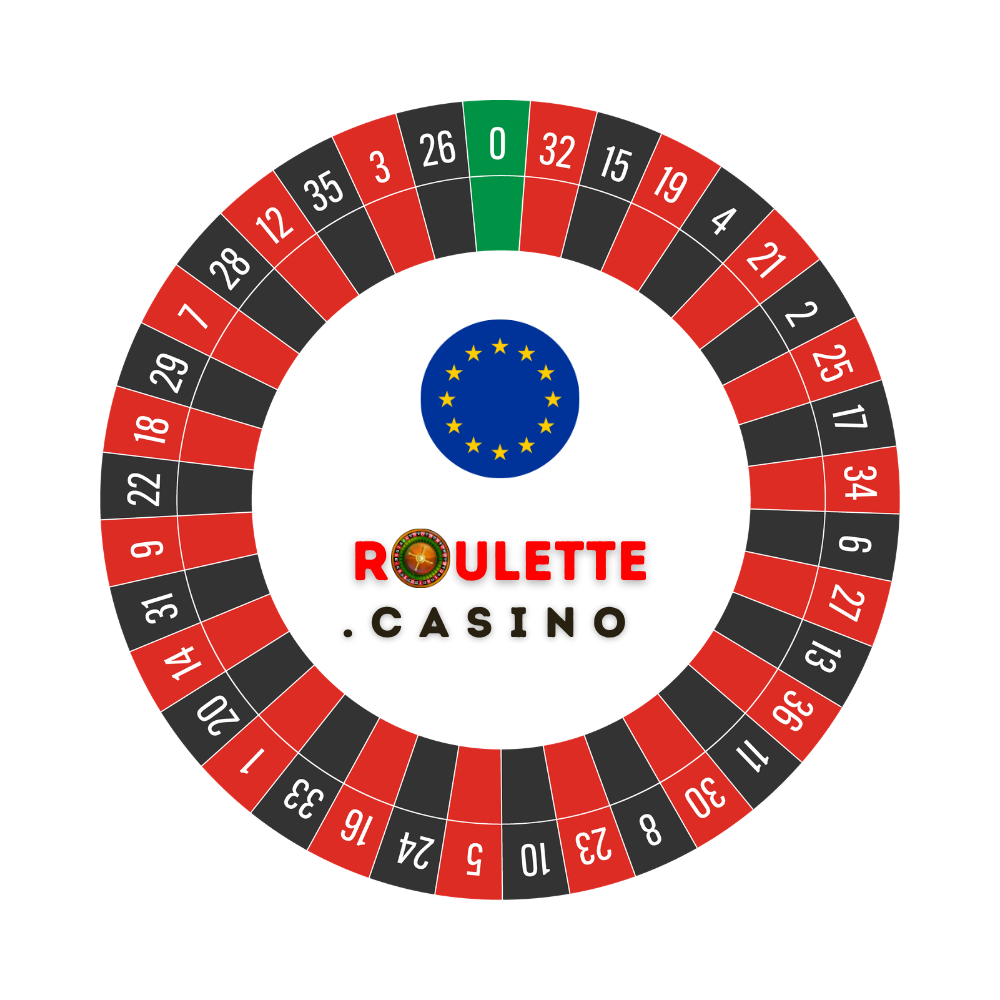
With 37 possible outcomes, a straight-up bet on one number wins 1 time in 37, or roughly 2.70% of the time. The payout for that winning bet is 35:1. A €10 stake on 17 returns €350 profit plus your original chip if the ball lands there.
That sounds even-handed until you do the arithmetic. A truly fair payout, one that exactly matched the probability, would be 36:1, not 35:1. The casino pays you one unit less than the math says it should. That missing unit, multiplied over thousands of spins across millions of players, is the house edge in its most physical form.
European Roulette Probability and Payouts at a Glance
| Bet type | Numbers covered | Probability | Standard payout |
|---|---|---|---|
| Straight-up | 1 | 1/37 = 2.70% | 35:1 |
| Split | 2 | 2/37 = 5.41% | 17:1 |
| Street | 3 | 3/37 = 8.11% | 11:1 |
| Corner | 4 | 4/37 = 10.81% | 8:1 |
| Line / six-line | 6 | 6/37 = 16.22% | 5:1 |
| Dozen | 12 | 12/37 = 32.43% | 2:1 |
| Column | 12 | 12/37 = 32.43% | 2:1 |
| Red / black | 18 | 18/37 = 48.65% | 1:1 |
| Odd / even | 18 | 18/37 = 48.65% | 1:1 |
| High / low | 18 | 18/37 = 48.65% | 1:1 |
Players tend to read this table from the right: payout first, then everything else. Specialists read it the other way around, focused on the gap between true probability and what the table actually pays. That gap is where the casino lives, quietly and consistently, without ever needing a hot streak of its own. The full win probability for every bet follows the same single rule: pockets covered divided by 37.
Payout Versus True Probability
Roulette payouts are easy to misread because, in isolation, they look generous. A 35:1 return on a straight-up number is genuinely large in any single spin. Stretch it across hundreds of spins and it becomes slightly worse than the underlying odds, every time.
The straight-up bet shows this neatly. The true chance of winning is 1 in 37, so a fair payout would be 36:1. The actual payout is 35:1. That one-unit shortfall is the entire mechanism.
Even-money bets work the same way. Red covers 18 numbers. Black covers 18 numbers. The green zero, lone and inconvenient, belongs to neither. So red and black are not the clean 50/50 propositions they appear to be. The real split is 48.65% to 51.35% against you. The difference looks trivial at the table. Over a long enough session, it is the only thing that matters.
What Is the Roulette House Edge?
The house edge is the casino’s mathematical advantage expressed over the long run. In European roulette it sits at 2.70%. In theory, for every €100 wagered over a very large sample, the expected loss is €2.70.
The word doing the heavy lifting there is “wagered.” Not deposited, not lost on the night, wagered. Sit down with €100, place twenty €5 bets, and you have wagered €100. Cycle wins and losses for an hour and the same starting balance can recycle into several thousand euros of total action.
Take a concrete picture. One hundred spins of €10 each adds up to €1,000 wagered. Apply the 2.70% house edge and the theoretical expected loss is €27. You could still finish the session up. You could also lose far more than €27. Both outcomes are consistent with the math, because house edge and RTP describe long-run averages, not session promises. Variance does not ask permission before showing up.
What Is European Roulette RTP?
RTP, return to player, is simply the house edge flipped. If the edge is 2.70%, the theoretical RTP is 97.30%. European roulette is designed to return €97.30 for every €100 wagered over a very large sample, with the remaining €2.70 kept as the house’s share.
The figure is widely quoted and almost as widely misunderstood. It does not mean depositing €100 should produce €97.30 by the end of the evening. It is a long-horizon metric, calibrated over enormous numbers of spins. Any individual session can swing well above or below it without breaking anything statistical.
A player who hits a straight-up number in their first ten spins has not beaten the game. They have, in that session, experienced its variance going their way. The wheel did not turn generous. It produced a high-variance outcome, which is exactly the kind of outcome it produces sometimes.
Why European Roulette Usually Beats American Roulette
European roulette has one zero. American roulette has two, 0 and 00, and that single extra pocket changes the entire economic shape of the game.
| Variant | Pockets | Zeroes | House edge | RTP |
|---|---|---|---|---|
| European roulette | 37 | 1 | 2.70% | 97.30% |
| American roulette | 38 | 2 | 5.26% | 94.74% |
The payouts themselves are mostly identical. A straight-up bet still returns 35:1. What changes is the denominator: that bet now covers 1 number out of 38 rather than 1 out of 37, so the casino keeps almost twice as much over the long run for offering essentially the same game.
This is why the single-zero wheel is the version players should learn first. When two tables look alike and one carries a single zero while the other adds 0 and 00, the single-zero table is the correct choice unless you enjoy paying extra for identical suspense. Practical, slightly boring, and one of the most consequential decisions a player ever makes.
Can AI Beat the European Roulette House Edge?
To beat European roulette, AI would need more than a feed of past numbers. It would need a real, structural edge, and the candidates are narrow.
A biased wheel
A physical wheel could, in theory, develop a bias: a pocket, rotor, ball track, or mechanical defect that produces a non-random distribution over time. This is the old advantage-play dream that occasionally surfaces in casino folklore and genuine advantage play.
Modern casino wheels are maintained, monitored, and rotated specifically to prevent that. In live dealer studios, operators have every incentive to catch bias early, because a persistently biased wheel is an operational disaster, not a quirky feature. Even if a real bias existed, detecting it needs clean data, large samples, and disciplined statistical testing. Number 22 appearing three times in ten spins is not a bias. It is roulette doing exactly what roulette does.
Mechanical data from a live wheel
Genuine physical prediction is a different discipline from reading a history board. It tries to measure wheel speed, ball speed, rotor direction, ball deceleration, release point, and the most likely landing sector, all before betting closes. That requires real-time physical access to the wheel, which is essentially never available to online players. Live streams add their own complications: camera angles, latency, bet timers, studio countermeasures. A tool that claims to “use AI to read recent spin history” is not doing physical prediction. It is pattern-chasing wearing a lab coat.
A flawed RNG or exposed seed
Online roulette powered by an RNG has no physical wheel to read at all. The result is generated by software, so predicting it would require a serious flaw in the random number generator, its seed handling, or its implementation. That is not a roulette strategy. That is a security incident.
Regulated RNGs are explicitly tested to prevent predictability. In credible crypto roulette, provably fair systems are designed to let players verify what already happened, not preview what is about to happen.
Why Spin History Does Not Predict the Next Number
Most AI prediction tools rely on a single trick: making the past feel meaningful. The dashboards are often impressive, with hot numbers, cold numbers, missing numbers, sector heat, red/black balance, odd/even balance, and “AI confidence” scores. Plenty of dashboards are impressive. That alone does not make them useful.
In European roulette, the probability of any straight-up number on the next fair spin is 1/37. That figure does not move because the number hit five minutes ago, and it does not move because it has been absent all afternoon.
Suppose the last ten spins were all black. What is the probability of black on the next spin? Still 18/37. Still 48.65%. Not lower because red is “due.” Not higher because black is “hot.” Just 48.65%, exactly as it was before any of those ten spins happened. The wheel has no memory. Players do, which is usually where the trouble starts. The hot and cold numbers view is fine as a record of what occurred. It is not a forecast.
Betting Systems Do Not Change European Roulette Odds
A surprising amount of roulette content quietly confuses betting systems with prediction. They are not the same thing. The Martingale system is the textbook example: double your bet after every loss, on the theory that a single win recovers the previous losses and leaves a small profit on top. The logic is impeccable right up until the losing streak shows up wearing boots.
Martingale does not change the probability of red, black, odd, even, high, or low. It does not change the payout. It does not remove the zero. It does not reduce the 2.70% house edge. All it changes is the rate at which your stakes escalate.
Starting from €10 on red, six straight losses look like this:
| Spin | Result | Next Martingale bet |
|---|---|---|
| Loss 1 | Lose €10 | €20 |
| Loss 2 | Lose €20 | €40 |
| Loss 3 | Lose €40 | €80 |
| Loss 4 | Lose €80 | €160 |
| Loss 5 | Lose €160 | €320 |
| Loss 6 | Lose €320 | €640 |
After six losses you are down €630 and need to put €640 on the next spin to continue the system. Table limits and bankroll limits are not theoretical objections, they arrive quickly and they arrive together. AI plus Martingale is still Martingale. It just has better marketing. The full range of betting strategies behaves the same way: each one reshapes volatility, none removes the edge.
Live Roulette: More Visible Does Not Mean More Predictable
Live roulette feels different because you can see everything: the wheel, the dealer, the ball, the studio. That visibility creates a powerful illusion that more information is on the table than there actually is.
Live interfaces often add result histories, hot and cold breakdowns, sector statistics, dealer names, pace indicators, multiplier overlays, and streak counters. These features improve engagement. They do not improve prediction, and they are not designed to. Live European roulette is still 37 pockets, one zero, and a 2.70% house edge.
Multiplier formats add a different wrinkle. Lightning-style and Mega-style games can boost payouts on selected numbers, but they typically compensate through modified payouts on other bets, higher overall volatility, or altered mechanics. That does not make them bad games. It makes them mathematically different ones, worth treating as such. Standard European roulette is cleaner. Live roulette is more immersive. Multiplier roulette is higher variance. None of those formats becomes predictable because the interface shows a list of recent results.
Crypto Roulette: Provably Fair Is Not Predictably Fair
Crypto roulette introduces a final layer of confusion, largely because “provably fair” gets read as if it means “transparent in both directions.” It does not. A well-implemented provably fair system uses server seeds, client seeds, hashes, and nonces to let players verify that a result was generated honestly after the fact. That is a useful trust mechanism. It is not a window into the next spin.
If you could derive the future result from the published commitments before betting, the system would not be provably fair, it would be broken. So the right question to ask a crypto roulette product is not whether AI can predict it, but whether you can verify the result, read the rules, and confirm the real RTP. Crypto roulette can be excellent: fast payments, privacy-focused design, transparent verification. It can also attract aggressive marketing and a steady supply of prediction-tool nonsense, so the underlying math still needs checking. If the layout is European, European probability applies. If the payout table is modified, look up the RTP. If the rules are hidden, leave.
What AI Can Actually Do for Roulette Players
AI is not useless for roulette. It is just useless as a magic number oracle. The genuinely valuable applications tend to be the unglamorous ones.
Bankroll simulations
AI can model how a bankroll behaves under different bet sizes, table limits, and losing streaks. Most players underestimate variance, and a simulation is the cheapest way to see it. A €200 bankroll and €25 outside bets sounds manageable until red misses six times in a row, at which point it has stopped being a bankroll and started being a memory.
Strategy stress-testing
Betting systems can be tested over thousands or millions of simulated spins. The results are usually dull and useful in equal measure: a given system may shift the shape of volatility, but it does not erase the house edge. Knowing that with conviction is worth more than reading another forum thread about the system that finally works.
Scam detection
AI is also useful for evaluating prediction-tool claims with a cold eye. If a product promises certain profit, 90% or 99% accuracy, results that “work on all roulette tables,” a system that “beats RNG roulette,” sessions with no losses, or access to a “secret casino algorithm,” you do not need a subscription. You need distance.
Learning roulette probability
AI is genuinely good at explaining the math: why a split bet pays 17:1, why dozens pay 2:1, why red and black are not true 50/50 bets, why European roulette outperforms American over time. Less exciting than predicting number 29, and also less fictional.
How to Evaluate Roulette Prediction Tools
Before paying for an AI roulette predictor, run it through a short interrogation. Does it explain the 2.70% European house edge openly? Does it separate RNG roulette from live roulette? Does it publish losing results alongside the highlight reel, or only the flattering screenshots? Does it specify what data signal it is actually using? Does it claim to predict before bets close, or only after? Does it account for table limits? Does it discuss bankroll risk? Does it make fixed win-rate claims that survive scrutiny? Does it lean on hot and cold numbers as if they were a forecasting input?
If a tool cannot explain why its prediction beats the actual odds, in plain numbers rather than vibes, it almost certainly does not. A glossy dashboard is not evidence. Neither is a single winning screenshot. Anyone who has played roulette for an hour has seen a winning session. The relevant question is always what happens over thousands of spins, and most prediction tools become noticeably less talkative when that question comes up.
Frequently Asked Questions
Can AI predict roulette numbers?
Not on a fair wheel. Each spin is independent, so past results carry no information about the next outcome. AI can describe spin history in impressive detail, but description is not prediction. The only ways to gain a real edge involve a physically biased wheel or a flawed RNG, both of which modern regulated operators work hard to prevent.
Does roulette prediction software actually work?
Tools that claim to predict outcomes from recent spin history do not work, because that history has no predictive value on a fair wheel. Genuine physical prediction, measuring wheel and ball speed in real time, is a different discipline that needs physical access most players never have. Anything marketed as “AI reads the history and tells you the next number” is pattern-chasing, not prediction.
Can AI beat the house edge?
No standard use of AI removes the 2.70% European house edge. AI can simulate bankrolls and stress-test systems, but the edge is built into the gap between true probability and payout. The only theoretical exceptions are exploiting a biased wheel or a broken RNG, neither of which is a reliable or legal strategy.
Is European or American roulette better for the player?
European, clearly. It has one zero and a 2.70% house edge against American roulette’s two zeros and 5.26%. The payouts are otherwise the same, so the American wheel costs you almost twice as much over time. Choose the single-zero wheel whenever both are available.
What is the most useful thing AI can do for a roulette player?
Protection rather than prediction. AI is good at modelling variance, stress-testing betting systems, spotting scam claims in prediction tools, and explaining the math clearly. Understanding why the edge cannot be beaten is more valuable than any dashboard promising to beat it.