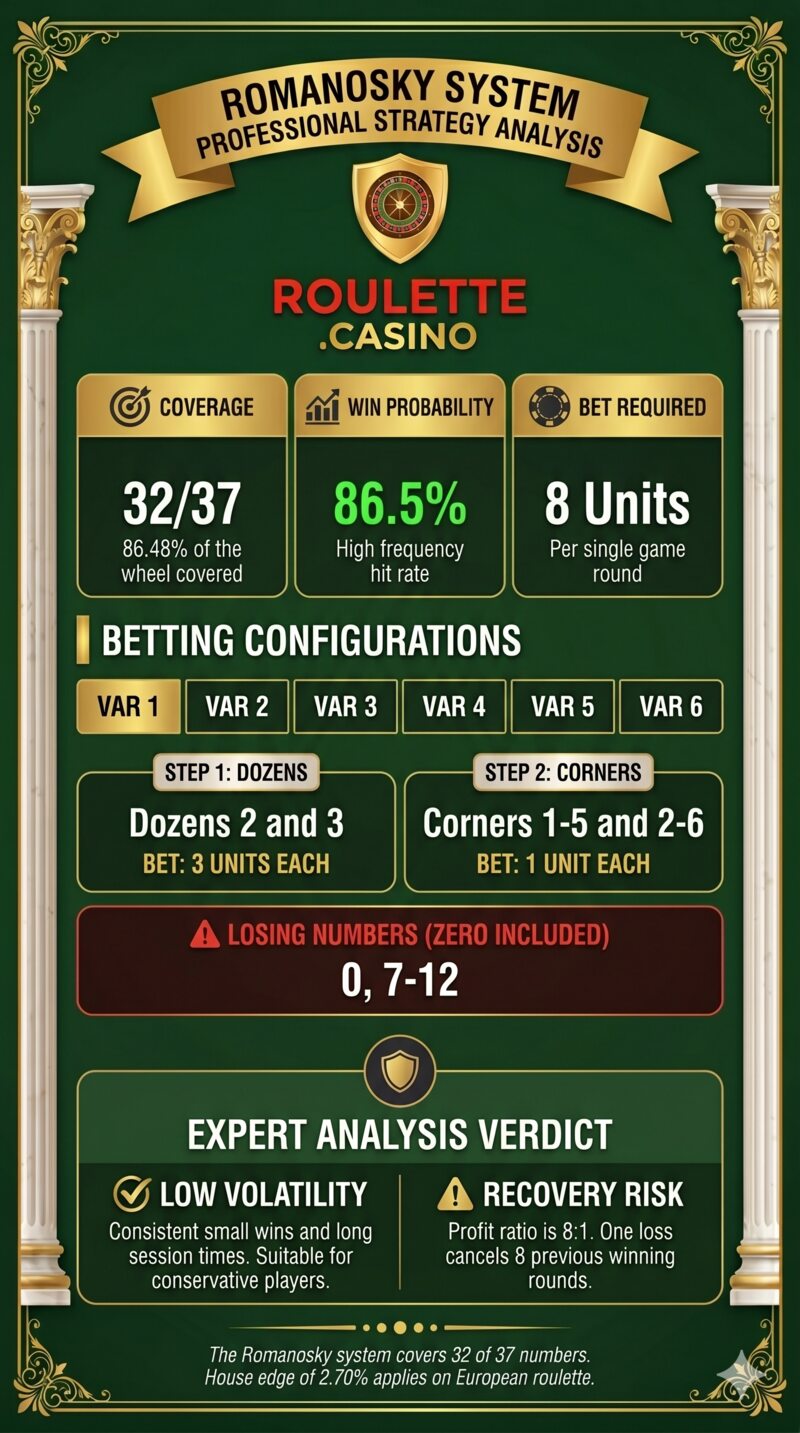
The Romanosky system covers 32 of the 37 numbers on a European wheel with a flat 8-unit bet per spin. That gives you an 86.5% chance of winning on any given spin, making it one of the highest-coverage betting methods in roulette. The catch is straightforward: each win returns exactly 1 unit of profit, so a single loss wipes out eight winning rounds. This page breaks down all six variations, the exact math behind the coverage, and an honest assessment of when the system works and when it does not.
How the Romanosky System Works
Each round uses exactly 8 units split across four bets: 3 units on one dozen, 3 units on a second dozen, and 1 unit each on two corner bets. The corner bets fill in numbers from the third dozen that the two dozen bets leave uncovered. The result is 32 numbers covered and 5 left exposed — always including zero.
Win on a dozen: the dozen pays 2:1, returning 9 units on a 3-unit bet, minus the 5 units lost on the other three bets. Net profit: 1 unit. Win on a corner: the corner pays 8:1, returning 9 units on a 1-unit bet, minus the 7 units lost on the other three bets. Net profit: 2 units minus 1 unit staked elsewhere — still 1 unit net. Lose: all 8 units are gone. The profit on every win is always exactly 1 unit regardless of which bet catches the ball.
All Six Variations
The six variations cover different sections of the wheel but follow the same structure. Every variation leaves exactly 5 numbers exposed: zero and four numbers from the uncovered dozen. Learn one variation and you understand all six.
| Variation | Dozen 1 (3 units) | Dozen 2 (3 units) | Corner X (1 unit) | Corner Y (1 unit) | Uncovered numbers |
|---|---|---|---|---|---|
| Romanosky 1 | 1–12 | 13–24 | 25-26-28-29 | 31-32-34-35 | 0, 27, 30, 33, 36 |
| Romanosky 2 | 1–12 | 13–24 | 25-26-28-29 | 32-33-35-36 | 0, 27, 30, 31, 34 |
| Romanosky 3 | 1–12 | 13–24 | 26-27-29-30 | 31-32-34-35 | 0, 25, 28, 33, 36 |
| Romanosky 4 | 1–12 | 25–36 | 13-14-16-17 | 19-20-22-23 | 0, 15, 18, 21, 24 |
| Romanosky 5 | 13–24 | 25–36 | 1-2-4-5 | 7-8-10-11 | 0, 3, 6, 9, 12 |
| Romanosky 6 | 1–12 | 25–36 | 14-15-17-18 | 20-21-23-24 | 0, 13, 16, 19, 22 |
You only need to memorise one variation to play. All six produce the same win probability and the same 1-unit net profit on every winning spin.
The Math Behind the Coverage
On a European single-zero wheel there are 37 pockets. The Romanosky covers 32, leaving 5 exposed. Win probability is 32/37 = 86.49%. Loss probability is 5/37 = 13.51%. Those figures do not change across the six variations.
Expected value per spin: (32/37 × 1) + (5/37 × -8) = 0.865 – 1.081 = -0.216 units. Over 37 spins at 8 units each you stake 296 units and expect to lose approximately 8 units total — equivalent to the standard 2.70% house edge on a European wheel. The system does not reduce the house edge. It changes the distribution of wins and losses, not the long-term outcome.
The Middle Column Principle
The second column of the roulette table — numbers 2, 5, 8, 11, 14, 17, 20, 23, 26, 29, 32, 35 — is covered in every single Romanosky variation without exception. No matter which combination of dozens and corners you choose, the entire middle column always falls within the covered zone. This is the structural reason the system achieves 32-number coverage with only 4 bets. The corner bets are positioned to plug the gaps in the third dozen, while the two dozen bets handle the first 24 numbers plus the middle column overlap in the third dozen.
Honest Assessment: Pros and Cons
The system suits a specific type of player. If you want frequent small wins and a structured session with predictable variance, it delivers that. If you want significant returns per session relative to your stake, it does not.
- High win frequency. Winning on 86.5% of spins keeps most sessions in positive territory for extended periods.
- Flat betting. No doubling after losses, no exponential exposure. Your maximum loss per spin is always exactly 8 units.
- Simple to execute. Four chip placements per spin, no mental arithmetic required mid-session.
- Works on European and French roulette. On French roulette with La Partage, zero returns half your dozen stakes, reducing the effective loss on zero hits to 5 units instead of 8.
- 1 unit profit per win. You need 8 consecutive wins just to cover one loss. A short losing streak can require a long recovery.
- Zero is always exposed. The house edge is fully intact. On American double-zero roulette the edge nearly doubles to 5.26%, making the system significantly worse.
- Slow bankroll growth. Even a solid session of 50 wins produces only 50 units of profit — less than the cost of 7 losses.
- Requires a large starting bankroll. A recommended minimum of 100 units means a €1-unit player needs €100 on the table before sitting down.
Bankroll Requirements
The standard recommendation from experienced players is a minimum of 100 units per session. At 8 units per spin that gives you 12 to 13 spins of buffer before your bankroll is depleted. In practice most players set a stop-loss of 50 units and a profit target of 10 to 20 units per session.
The probability of losing 5 consecutive rounds is (5/37)^5 = approximately 0.013%, which sounds low. Over a long session of 500 spins that event has a meaningful probability of appearing at least once. Plan your bankroll for it, not against it. For further context on how session variance affects any betting system, see our full winning chances breakdown.
Romanosky vs Martingale
The two systems are structurally opposite. The Martingale doubles your bet after every loss, chasing recovery with exponentially growing stakes. The Romanosky keeps your bet fixed at 8 units regardless of recent results. That difference matters in practice.
Martingale players face table limits that cap how far they can double. After 7 consecutive losses on a €5 starting bet, the required next bet is €640 — above most online table maximums. Romanosky players face no such limit. Their exposure per spin never changes. The trade-off is that Martingale recovers all previous losses the moment a win lands, while Romanosky needs 8 wins to recover from a single loss.
Neither system changes the house edge. The choice between them is a choice about loss distribution: concentrated large losses occasionally (Martingale) versus small frequent losses that accumulate over time (Romanosky). Compare both alongside other approaches on our roulette strategies overview. For a lower-volatility flat system without sector betting, flat betting is worth comparing directly.
Frequently Asked Questions
What is the Romanosky roulette system?
The Romanosky system is a flat betting strategy that covers 32 of 37 numbers on a European roulette wheel using 8 units per spin. You place 3 units on each of two dozens and 1 unit on each of two corner bets. Every win returns a net profit of exactly 1 unit. There are six variations, all producing the same 86.5% win probability.
Does the Romanosky system beat the house edge?
No. The expected value per spin is negative regardless of which variation you use. The system distributes wins and losses differently from simpler bets, but the underlying 2.70% house edge on European roulette applies to every spin. No betting system eliminates the house edge.
Which roulette variant works best with the Romanosky system?
European single-zero roulette. The 2.70% house edge is half that of American double-zero roulette (5.26%). French roulette with La Partage is the best option: when zero hits, half your dozen stakes are returned, reducing the effective loss on zero from 8 units to around 5 units and cutting the house edge on those bets to 1.35%.
How much bankroll do I need for the Romanosky system?
A minimum of 100 units is the standard recommendation. At 8 units per spin that gives roughly 12 spins of buffer. Most players set a hard stop-loss at 50 units and a session profit target of 10 to 20 units before sitting down. Without a stop-loss, a short sequence of losses can eliminate a session bankroll quickly.
What are the five uncovered numbers in the Romanosky system?
Zero is always uncovered in every variation. The other four exposed numbers come from the third dozen not covered by the two dozen bets, and depend on which corners you choose. Each variation leaves a different set of four numbers exposed alongside zero. See the variation table above for the exact uncovered numbers in each of the six versions.
Can the Romanosky system be combined with the Martingale?
Yes, in theory. The Martingale governs bet size while the Romanosky governs bet placement, so they can be layered. In practice, combining them amplifies the bankroll risk significantly: after a loss you would double the entire 8-unit stake to 16 units, and after two losses to 32 units. The table limit problem that undermines standalone Martingale play applies here too. Most experienced players avoid combining the two.
Is the Romanosky system suitable for beginners?
It is one of the more beginner-friendly systems because the bet placement is fixed and requires no calculation mid-session. Learn one variation, place the same four bets every spin, and track your session against a pre-set stop-loss and profit target. The main risk for beginners is underestimating how quickly losses accumulate when a streak of five uncovered numbers hits.
Best Roulette Casinos
Full reviewsTop Roulette Casino
Best live selection · Lightning, Quantum, Immersive & more
Premium Live Tables
50+ live roulette tables · No withdrawal limits · Fast payouts
Best for High Rollers
VIP roulette tables · €10,000+ bet limits · Personal account manager
Best Crypto Casino
Bitcoin & ETH roulette · Provably fair · Instant withdrawals