
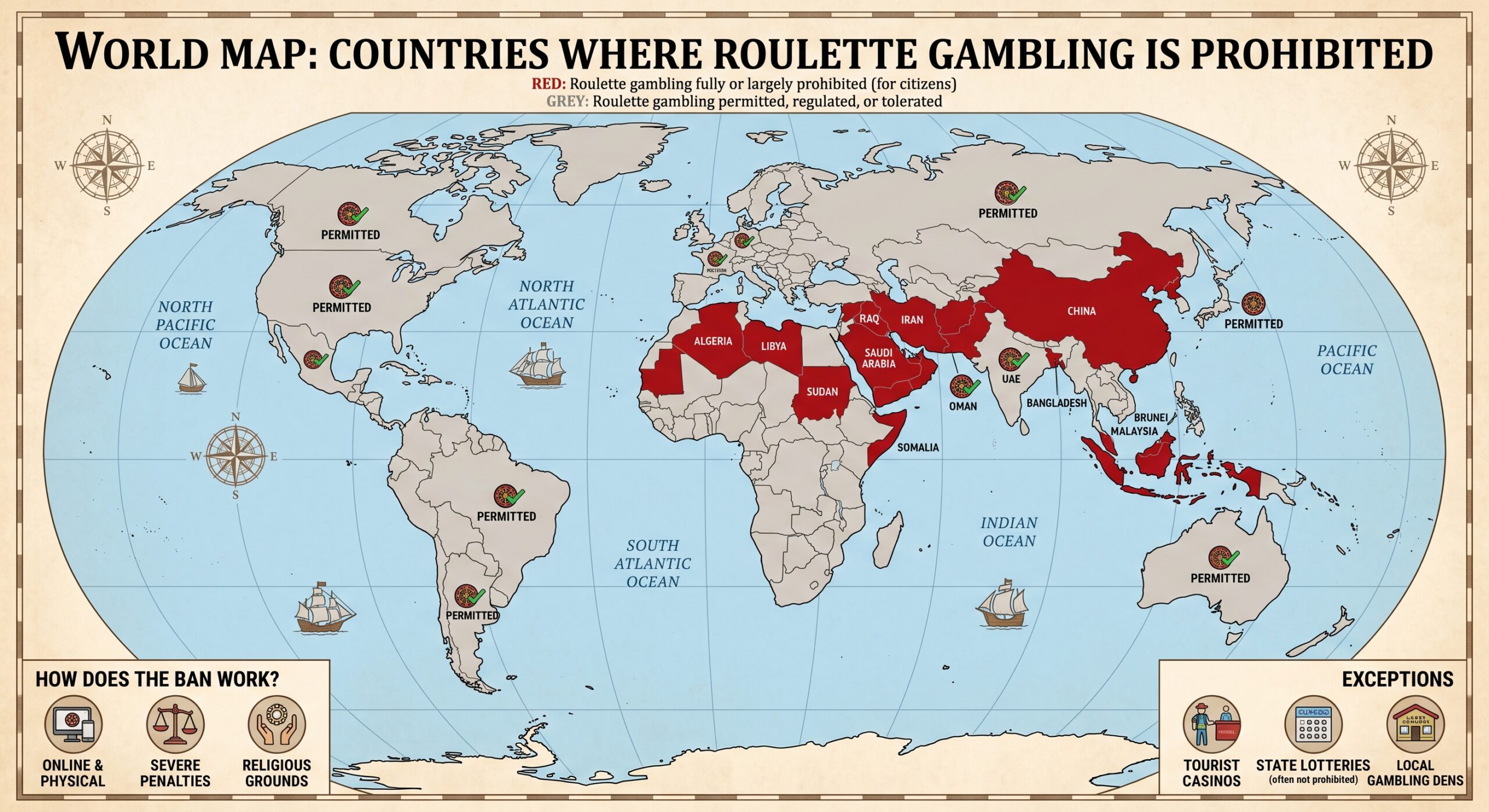
Whether you may legally play roulette for money is decided by one thing: where you are sitting, not where the operator is registered. Millions of people play online roulette worldwide, but the rules differ sharply per country — what is fully licensed in one market is a criminal offence in the next. This page explains how the regulation works, which markets are regulated, which restrict or ban play entirely, and what remains your own responsibility.
The Licence Is Not the Law
Online gambling regulation has two layers, and both have to line up before playing is legal. The first layer is the operator’s licence: an authority such as the UK Gambling Commission or the Malta Gaming Authority audits the games, the payouts and the handling of player funds. The second layer is the law of the country you are in, which decides whether that operator may serve you at all. An operator with a perfectly valid licence somewhere else does not make playing legal where you live — the licence has to cover play from your country. What each authority actually requires from an operator is set out on the roulette apps for real money page.
Regulated Markets
In regulated markets, online roulette is legal through licensed operators, with player protections written into law. Some examples:
| Market | Status | Regulation |
|---|---|---|
| United Kingdom | Legal | Licensed by the UK Gambling Commission |
| Netherlands | Legal, strict conditions | Regulated by the Kansspelautoriteit |
| Germany | Partially legal | Restrictions apply specifically to online casino games |
| United States | Per state | Legal in some states, banned in others; geolocation enforced |
| Canada | Largely legal | Regulated per province |
| Australia | Land-based only | Casinos are legal, but online casino games are prohibited for residents |
Everywhere else, the answer depends on local law — and “not explicitly regulated” is not the same as “allowed”.
Restricted and Banned Markets
At the other end of the spectrum stand countries where roulette is restricted or banned outright. Four examples show how differently that can be arranged.
Qatar: zero tolerance
Qatar maintains some of the strictest gambling laws in the world: all forms of gambling are illegal, including sports betting and lotteries. There is no legal framework for gambling of any kind, and the sweeping ban has pushed what activity exists underground. For residents and travellers alike, any betting activity carries real legal risk.
Lebanon: a state-controlled exception
Lebanon bans its citizens from gambling in general and actively blocks access to international gambling sites. The exception is state-controlled: Casino du Liban, the sole licensed land-based operator north of Beirut, plus government-monitored online access operating under state oversight. Everything outside that structure is off-limits.
Thailand: prohibition since 1935
Under Thailand’s Gambling Act of 1935, almost all forms of gambling are illegal — no roulette wheels, no casinos open to the public. The only major legal exceptions are the national lottery and betting on certain horse races. Legalising casino “entertainment complexes” keeps resurfacing in Thai politics, but the proposals have not made it into law, so the prohibition stands.
Singapore: the foreigners-only model
Singapore takes a pragmatic two-tier approach, designed to capture tourism revenue while shielding its own population. The integrated resorts, such as Marina Bay Sands, are world class — but residents are discouraged through high entry levies, while foreigners may play freely provided they meet the entry requirements. Same table, different rules depending on your passport.
| Country | Status of roulette | Key restriction |
|---|---|---|
| Qatar | Illegal | Total ban on all forms of gambling |
| Lebanon | Restricted | Only in state-controlled venues |
| Thailand | Illegal | Strict prohibition; only lottery and horse racing exempt |
| Singapore | Partial | Open to foreigners; entry levies discourage locals |
Your Responsibility
Before playing roulette for money anywhere, three things are yours to verify: that online play is legal in your country, that the operator holds a licence covering play from your country, and that you are of legal gambling age there (18+, or 21+ depending on the jurisdiction). If you are unsure about your local laws, seek legal advice rather than guessing.
About Roulette.casino
Roulette.casino is not a gambling operator. We do not run a casino, offer real-money games or promote illegal gambling — this site provides educational content about roulette, and some pages link to external platforms that are not available in all regions. By using this site you confirm that you are of legal gambling age in your country, that you have verified your local laws, and that you use the information here at your own risk. The full framework is set out in our general terms and conditions and disclaimer.