
If you have ever stared at a roulette table wondering whether a corner bet pays more than a split, or whether French rules actually change your expected loss in a meaningful way, you are asking the right questions. Roulette looks chaotic, but every wager on the felt has a fixed payout, a fixed probability, and a fixed long-term cost to you as the player. The maths is settled. The only thing that varies is whether you can recall it at the table and whether the version of roulette you are playing applies special rules that quietly shift the numbers in your favour.
That is the gap our Roulette Payout Calculator is built to close. It is a simple tool with a non-trivial job: take any bet you can place at any common roulette variant, factor in La Partage or En Prison where they apply, and return both the payout and the true house edge for that wager. Why the European and French variants quietly outperform American roulette, and how to read the output without falling into the most common probability traps.
- What the calculator actually does
- Payouts vs. odds: the distinction that costs players money
- Why variant selection matters more than bet selection
- La Partage and En Prison: rules that cut the edge in half
- Worked examples: reading the output
- From single bets to session math
- Common mistakes when interpreting payout tables
- Frequently asked questions
What the calculator actually does
At its core, a roulette payout calculator answers two questions for any bet you might place:
- If this bet wins, how much do I receive? This is the payout ratio — 35:1 on a straight-up number, 2:1 on a column, 1:1 on red or black, and so on. These ratios are identical across all standard roulette variants.
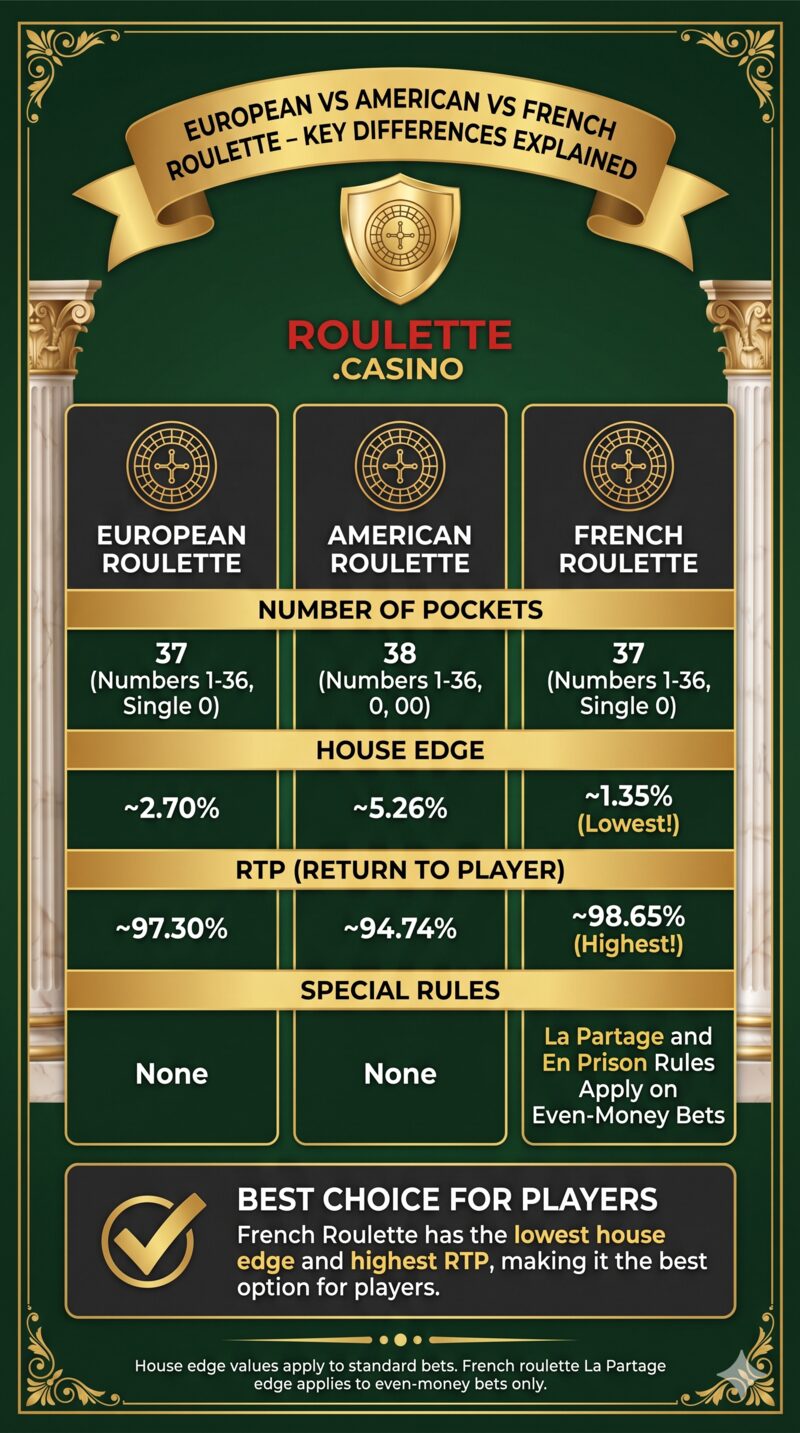
- What is my actual expected return on this bet? This is where the variant matters enormously. The same red/black bet costs you 2.70% in long-run expectation on European roulette, 5.26% on American roulette, and as little as 1.35% on French roulette with La Partage. The payout ratio hides this — only the house edge reveals it.
The calculator strips away the noise. You select your variant, choose a bet type, enter a stake, and the output gives you the gross win, the net profit, and the underlying probability and edge. No marketing language, no “lucky number” suggestions — just the maths that governs every spin you will ever play.
Quick frame of reference: Every bet in roulette has the same expected loss per spin on a given wheel, with the single exception of the basket bet on American roulette (the 0-00-1-2-3 five-number wager), which has a worse house edge of 7.89%. Otherwise, the edge is structural to the wheel, not the bet. This is the most important fact in the game.
Payouts vs. odds: the distinction that costs players money
Players routinely conflate three numbers that mean very different things: the payout, the true odds, and the house edge. The calculator separates them deliberately, because confusing them is how players end up convinced that some bets are “better” than others when, mathematically, they are not.
A straight-up bet on a single number pays 35:1. The true odds of that number hitting on a European wheel are 36:1 (one winning slot out of 37 total slots). That single-unit gap — between the 35 you receive and the 36 you statistically deserve — is the entire house edge, distributed across every bet on the table. On an American wheel with two zeros, the gap doubles to two units out of 38, which is why the edge rises to 5.26%.
This relationship holds for every bet type. A red/black wager pays 1:1, but your probability of winning is 18/37 on European (48.65%), not 50%. The “missing” probability is the zero, which is neither red nor black and which — in the absence of special rules — simply loses your even-money bet outright. Understanding this is the difference between playing roulette consciously and playing it as a guessing game.
For a deeper breakdown of every bet’s payout ratio and probability, see our full odds and payouts guide. For the underlying mathematics of why the edge exists at all, the house edge explainer walks through the derivation step by step.
Why variant selection matters more than bet selection
If there is one single piece of advice that disciplined roulette players follow, it is this: choose your wheel before you choose your bet. The difference between European and American roulette is roughly a 2.56-percentage-point swing in the house edge — and that difference compounds aggressively over a session. Over 100 spins at a $10 average stake, the expected cost difference between the two variants is around $25. Over 1,000 spins, that becomes $250 — for making identical betting decisions on a worse wheel.
| Variant | Pockets | House edge (standard) | With La Partage / En Prison |
|---|---|---|---|
| European Roulette | 37 | 2.70% | — |
| French Roulette | 37 | 2.70% | 1.35% on even-money bets |
| American Roulette | 38 | 5.26% | — |
| Single Zero (no special rules) | 37 | 2.70% | — |
| Double Zero with Surrender | 38 | 5.26% | 2.63% on even-money bets |
The table above is the entire reason variant matters. If you only ever take one lesson from a payout calculator, take this: an even-money bet on French roulette with La Partage costs you less than half what the same bet costs on American roulette. You are not playing a different game in any meaningful sense — same wheel layout in most respects, same bet types, same payouts — but the structural edge against you is dramatically lower.
This is why we recommend European or French roulette over American roulette for any serious play. The American wheel exists primarily for historical and casino-economic reasons; it is not a superior game by any player-facing metric.
La Partage and En Prison: the rules that cut the edge in half
The calculator handles two French-roulette rules that most casual players have never heard of, despite the fact that they roughly halve the cost of even-money play.
La Partage (“the divide”) applies when the ball lands on zero and you have placed an even-money bet — red/black, odd/even, or high/low. Instead of losing the entire stake, you lose only half. The other half is returned to you. Because the zero pocket is the entire source of the house edge on these bets, halving its impact halves the edge: 2.70% becomes 1.35%.
En Prison (“in prison”) is the variant rule. When the ball lands on zero, your even-money stake is not lost — it is “imprisoned” for the next spin. If that next spin wins, the original stake is returned (without winnings); if it loses, the stake is forfeit. Mathematically, En Prison delivers the same 1.35% edge as La Partage in the long run, but the experience at the table is different: you either lose nothing extra or you lose the full stake on the next outcome.
Important caveat: La Partage and En Prison only apply to even-money bets. They do not protect you on column, dozen, split, corner, or straight-up wagers. If you are playing French roulette but mostly betting on numbers and corners, you are getting the standard 2.70% edge — the same as European — not the reduced 1.35%.
For a full treatment of these rules and how they interact with broader strategy, see our dedicated La Partage and En Prison guide.
Worked examples: reading the output
Example 1: $20 on red, European roulette
- Payout ratio: 1:1
- Win probability: 18/37 = 48.65%
- Gross win on success: $40 (your $20 stake plus $20 winnings)
- Expected value: −$0.54 per spin (a long-run cost of 2.70% of stake)
If you place this bet 100 times at $20 each, your expected long-run loss is $54. You will experience significant variance around that number — winning sessions and losing sessions — but the expectation is fixed.
Example 2: $20 on red, French roulette with La Partage
- Payout ratio: 1:1 on win, half-loss on zero
- Win probability: 18/37 = 48.65%
- Zero probability: 1/37 = 2.70%, but you only lose $10 instead of $20
- Expected value: −$0.27 per spin (a long-run cost of 1.35% of stake)
Same wheel layout, same payout, identical-looking bet — but the long-run cost is exactly half. Over 100 such bets, your expected loss is $27 instead of $54.
Example 3: $5 straight-up on 17, American roulette
- Payout ratio: 35:1
- Win probability: 1/38 = 2.63%
- Gross win on success: $180 (your $5 stake plus $175 winnings)
- Expected value: −$0.26 per spin (a long-run cost of 5.26% of stake)
Note that the absolute expected loss in dollar terms ($0.26) looks similar to Example 2 ($0.27), but the stake is one quarter of the size. Per dollar wagered, the American straight-up bet costs nearly four times what the French even-money bet costs. This is what variant choice does.
From single bets to session math
A payout calculator tells you the cost of a single bet. Session math tells you the cost of an evening. The two are connected by a multiplier most players underestimate: total wager volume.
Live roulette tables run roughly 30 spins per hour. Online RNG roulette can comfortably hit 60–80 spins per hour, and turbo or auto-roulette variants exceed 100. If you bet $10 per spin at a turbo table for three hours, you have wagered $3,000 in total volume — even if your bankroll never dropped below $200. At a 2.70% edge, your expected loss is $81. At 5.26%, it is $158. At 1.35%, it is $40.50.
This is why fast-paced variants amplify variant choice. The combination of a high-edge wheel and a high-velocity format is the worst player environment in the game. Conversely, a low-edge wheel played at a moderate pace is one of the cheapest forms of casino entertainment available — provided your bet sizing is disciplined.
If you want to see this play out without risking money, our roulette simulator lets you run thousands of spins under any rule set and observe how the expected loss converges to the theoretical edge over time. It is the most direct way to internalise why “I felt lucky” is not a strategy.
Common mistakes when interpreting payout tables
- Treating payout as profit. A 35:1 payout means you receive 35 units of profit plus your original stake back. Some sources quote this as “36 for 1” (you give up your stake and receive 36 total). Both formats describe the same bet, but it is worth checking which convention a payout chart is using before drawing conclusions.
- Assuming “better odds” exist on the table. They don’t. On a given variant, every bet (except the American basket) has the same house edge. A column bet is not “safer” than a straight-up bet in any meaningful sense — it has lower variance, but the same expected loss per unit wagered.
- Ignoring rule variations. Two casinos can both advertise “French Roulette” and offer materially different games depending on whether La Partage applies, whether En Prison is offered, and whether the rule applies to all even-money bets or only red/black. Always check the rules screen before sitting down.
- Misreading announced bets. French roulette includes “called bets” or “announced bets” (Voisins du Zéro, Tiers du Cylindre, Orphelins) which are combinations of multiple straight-up and split bets. The calculator handles these by decomposing them into their component wagers — the payout structure is just the weighted average of the underlying bets, not a special rule.
Frequently asked questions
Does the payout calculator work for live dealer roulette?
Yes. The maths is identical for live dealer and RNG roulette — only the presentation differs. Select the variant the live table uses (European, French, American, or a specialty format like Lightning Roulette) and the calculator returns the same results. For multiplier-based games like Lightning Roulette, the payout structure changes on straight-up bets but the underlying probability does not; see our live dealer guide for variant-specific notes.
Why is the basket bet on American roulette flagged separately?
The 0-00-1-2-3 five-number bet is the only wager in standard roulette that does not share the variant’s overall house edge. It pays 6:1, but the true odds make it a 7.89% edge bet — worse than every other American roulette wager. The calculator flags it because no informed player should ever place it; it is a historical relic of casino table design.
Can the calculator factor in bonuses or wagering requirements?
Not directly. The calculator returns mathematical expected value for a clean bet. Bonus money typically carries wagering requirements that distort effective expected value — sometimes favourably, often not. Our bonus guide covers how to evaluate offers with roulette-specific contribution rates.
What is the lowest house edge I can realistically play?
For practical purposes, 1.35% on even-money French roulette bets with La Partage is the floor at most regulated casinos. A handful of operators offer “No Zero Roulette” (0.00% edge) but these are rare, often restricted to high-roller rooms or used as promotional products with strict wagering limits. Treat them as the exception, not the rule.
Roulette rewards players who understand what they are buying with each chip placed. The payout calculator is not a system, a guarantee, or an edge — it is a clarity tool. Used consistently, it does the one thing that genuinely improves outcomes over time: it forces you to make conscious choices about variant, bet type, and stake before the ball drops.